
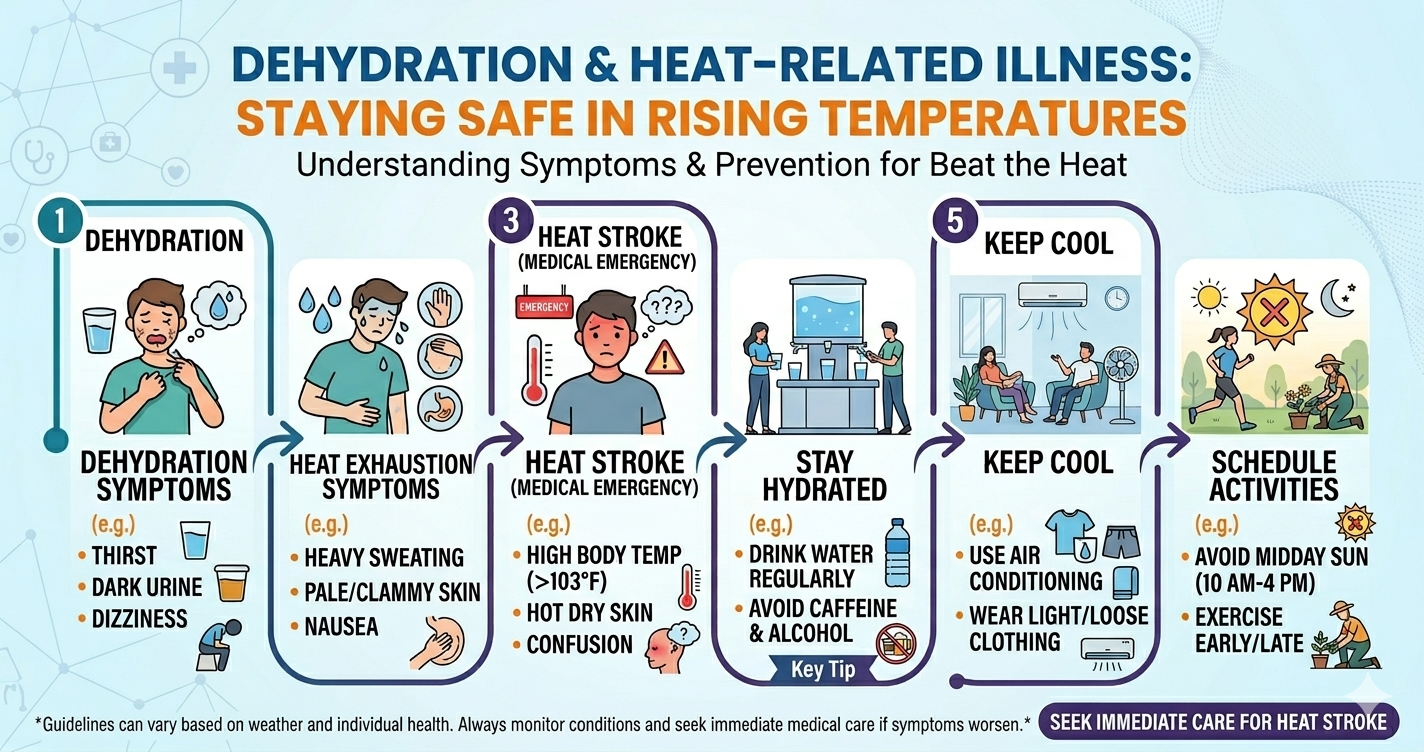
As temperatures continue to rise across many parts of the world, heat-related health concerns are becoming increasingly common. Prolonged exposure to high temperatures can lead to dehydration and serious heat-related illness, affecting people of all ages. Understanding the warning signs and learning how to avoid dehydration can help protect your health during extreme weather conditions.
Key Takeaways
- Thirst means you are already dehydrated. By the time you feel thirsty, your body has already lost enough fluid to affect performance and organ function.
- Infants and older adults are at the highest risk. Infants cannot communicate thirst and lose fluids faster than adults. Older adults have a diminished thirst response.
- Heat stroke is a medical emergency, not a severe headache. When a person stops sweating, becomes confused, or loses consciousness in the heat, do not wait. Call emergency services immediately.
- Dehydration and heat illness are deeply connected. Dehydration reduces the body’s ability to sweat and cool itself, accelerating the path from heat cramps to heat exhaustion to heat stroke.
- Prevention costs nothing; treatment can cost everything. Globally, approximately 489,000 people die from heat-related causes every year (WHO).
Understanding Dehydration
Dehydration occurs when the body loses more fluids than it takes in. Water plays a crucial role in maintaining body temperature, supporting circulation, and enabling organs to function properly. When fluid levels drop, the body begins to show warning signs.
One of the earliest physical changes people may notice is dehydrated skin, which may appear dry, less elastic, or rough. Other symptoms can include fatigue, dizziness, headache, dry mouth, and dark-colored urine.
According to the World Health Organization (WHO), even a water loss of approximately 2% of body weight can impair normal physiological processes. A loss of around 3% increases the risk of muscle cramps and raises the risk of heat stroke.
Can dehydration cause fever?
Dehydration does not directly cause fever in the traditional sense. However, dehydration impairs the body’s thermoregulation system. Without sufficient fluids, the body cannot produce enough sweat to cool itself. This can cause core body temperature to rise, producing fever-like symptoms such as feeling hot, flushed skin, and fatigue. In severe cases, the inability to cool down can escalate into genuine hyperthermia and, ultimately, heat stroke. See: Buoy Health — Can Dehydration Cause Fever?
Types of Dehydration
Medical experts classify dehydration based on how fluids and electrolytes are lost. According to NIH StatPearls (2024), the three main types are:
1. Isotonic Dehydration
Equal loss of water and sodium. Most common type — occurs during excessive sweating, vomiting, or diarrhea.
2. Hypertonic Dehydration
More water is lost than sodium. Typical in hot weather when people do not drink enough fluids. Cells shrink as fluid shifts out, affecting brain function in severe cases.
3. Hypotonic Dehydration
More sodium lost than water, often from excessive sweating without proper electrolyte replacement or certain medical conditions.
The American Academy of Pediatrics (AAP) classifies dehydration by severity: mild (less than 5% weight loss in infants), moderate (5–10%), and severe (greater than 15%), which guides whether oral or intravenous rehydration is needed.
Signs of Dehydration in Infants
Infants are especially vulnerable to dehydration. According to NIH StatPearls (2024), infants have a higher percentage of total body water — approximately 65–80%, than adults, and cannot communicate thirst. Globally, diarrheal disease and dehydration account for 14 to 30 per cent of deaths among infants and toddlers worldwide. In the US alone, approximately 200,000 children require hospitalisation annually for dehydration-related conditions, according to Medscape.
Common signs of dehydration in infants include:
• Fewer wet diapers than usual
• Dry mouth or cracked lips
• Sunken soft spot (fontanelle) on the head
• Lack of tears while crying
• Unusual sleepiness or irritability
• Sunken eyes
• Skin that does not spring back when gently pinched
If any of these symptoms appear, seek immediate medical attention. Dehydration in infants can deteriorate rapidly.
Heat-Related Illness: A Growing Global Crisis
According to a 2024 study in eClinicalMedicine / The Lancet, between 2000 and 2016, the number of people experiencing heatwaves increased by approximately 125 million. In Europe, 62,775 heat-related deaths were recorded in summer 2024 — a 23.6% rise from 2023. Globally, approximately 489,000 heat-related deaths occurred each year between 2000 and 2019, according to the WHO. The 2024 Lancet Countdown Report found that heat-related deaths among adults over 65 have more than doubled between 1990–1999 and 2014–2023.
Types of Heat-Related Illness
Heat Cramps
Painful muscle cramps caused by heavy sweating and electrolyte loss. Usually affects the legs, arms, or abdomen. This is the mildest form of heat-related illness.
Heat Exhaustion
A more serious condition marked by weakness, nausea, excessive sweating, pale skin, and dizziness. Core temperature is typically still below 104°F (40°C).
Heat Stroke
The most severe heat-related illness. Core body temperature exceeds 104°F (40°C). The person may stop sweating, become confused, or lose consciousness. Heat stroke is a life-threatening emergency. Call emergency services immediately.
Heat-Related Illness Symptoms
Common signs include:
• Heavy, excessive sweating
• Painful muscle cramps
• Headache or severe dizziness
• Rapid or weak heartbeat
• Nausea or vomiting
• Confusion or difficulty thinking clearly
• Fainting or loss of consciousness
• Hot, red, or dry skin (in heat stroke)
Heat-Related Illness Treatment
Prompt action is critical. The following steps are aligned with WHO guidelines:
- Move the person to a cool or shaded environment immediately.
- Apply cool, wet cloths to the neck, armpits, and groin. Use fans to encourage evaporation.
- Provide cool water or electrolyte drinks if the person is conscious and able to swallow. Avoid alcohol, caffeine, or sugary drinks.
- Loosen tight clothing and remove excess layers.
- Monitor breathing, pulse, and level of consciousness. Do not leave the person alone.
- Call emergency services for heat stroke. Continue cooling while waiting for help.
Research published in Nature Medicine (2025) highlights that adaptation efforts including public health interventions, have reduced heat-related mortality in Europe by as much as 80%.
How to Avoid Dehydration During Hot Weather
• Drink water before you feel thirsty. Thirst signals that mild dehydration is already present.
• Aim for pale yellow urine as a practical hydration indicator.
• Avoid alcohol, caffeine, and sugary drinks in the heat. All have a dehydrating effect.
• Eat water-rich foods: cucumber, watermelon, celery, tomatoes, and strawberries.
• Wear lightweight, loose, light-colored, breathable clothing.
• Schedule outdoor activity for cooler parts of the day.
• Take regular breaks in the shade or indoors when working outside.
How to Prevent Dehydration in Daily Life
According to a Virginia DBHDS dehydration guidance document (2024), high-risk groups include infants, older adults, people with chronic illnesses, and anyone dependent on others for fluid access. Daily prevention steps include:
• Carry a reusable water bottle as a visual reminder to drink.
• Set reminders to drink water every one to two hours when focused on work.
• Increase fluid intake during exercise, at least 150 to 250 ml every 15 to 20 minutes.
• Monitor urine colour regularly. Pale straw = well hydrated. Dark amber = drink now.
• Pay extra attention to infants, older adults, athletes, and people with chronic illnesses such as diabetes.
• In illness involving fever, vomiting, or diarrhea, use oral rehydration salts rather than plain water alone.
Stay Hydrated, Stay Safe
Rising temperatures make dehydration and heat-related illness a growing public health concern. Recognising heat-related illness symptoms, understanding the types of heat-related illness, and identifying early signs of dehydration can prevent serious complications.
By staying hydrated, limiting exposure to extreme heat, and acting quickly when symptoms appear, individuals can significantly reduce their risk. Prioritising hydration is a simple but powerful step toward protecting your health during hot weather.
FAQs
1. Can dehydration cause fever?
Dehydration does not directly cause fever the way an infection does. However, when the body lacks enough fluids to regulate temperature through sweating, core body temperature can rise and produce fever-like symptoms, flushed skin, feeling hot, and fatigue.
2. What are the earliest signs of dehydration in infants?
The earliest warning signs are fewer wet diapers than usual, a dry or sticky mouth, and crying without producing tears. As dehydration progresses, the fontanelle (soft spot on the head) may appear sunken, and the infant may become unusually sleepy or irritable.
3. What is the difference between heat exhaustion and heat stroke?
Heat exhaustion is serious but not immediately life-threatening. The person typically sweats heavily, feels weak or dizzy, and has a core temperature below 104°F (40°C). Heat stroke occurs when core temperature exceeds 104°F.
4. How much water should you drink in hot weather?
General guidance is at least 2 to 2.5 litres (8 to 10 cups) of water per day, rising to 3 or more litres during hot weather or physical activity. During exercise, aim for 150 to 250 ml every 15 to 20 minutes.
5. Are sports drinks better than water for rehydration?
For everyday hydration and mild dehydration, water is sufficient. Sports drinks and oral rehydration solutions become beneficial when dehydration is caused by prolonged sweating, illness, or significant electrolyte loss, situations where sodium and potassium also need replacing.
6. Who is most at risk of heat-related illness?
The highest-risk groups are infants and young children, adults over 65, outdoor workers, athletes, people with chronic conditions such as diabetes or heart disease, and anyone on medications that affect fluid balance.
7. What should you do if someone collapses from heat stroke?
Act immediately. Call emergency services first. Then move the person to the coolest available location, remove excess clothing, and cool the body as rapidly as possible, using cool water immersion if available, or cool wet cloths on the neck, armpits, and groin. Fan the person to promote evaporation. Do not give fluids to an unconscious person. Do not leave them alone.