
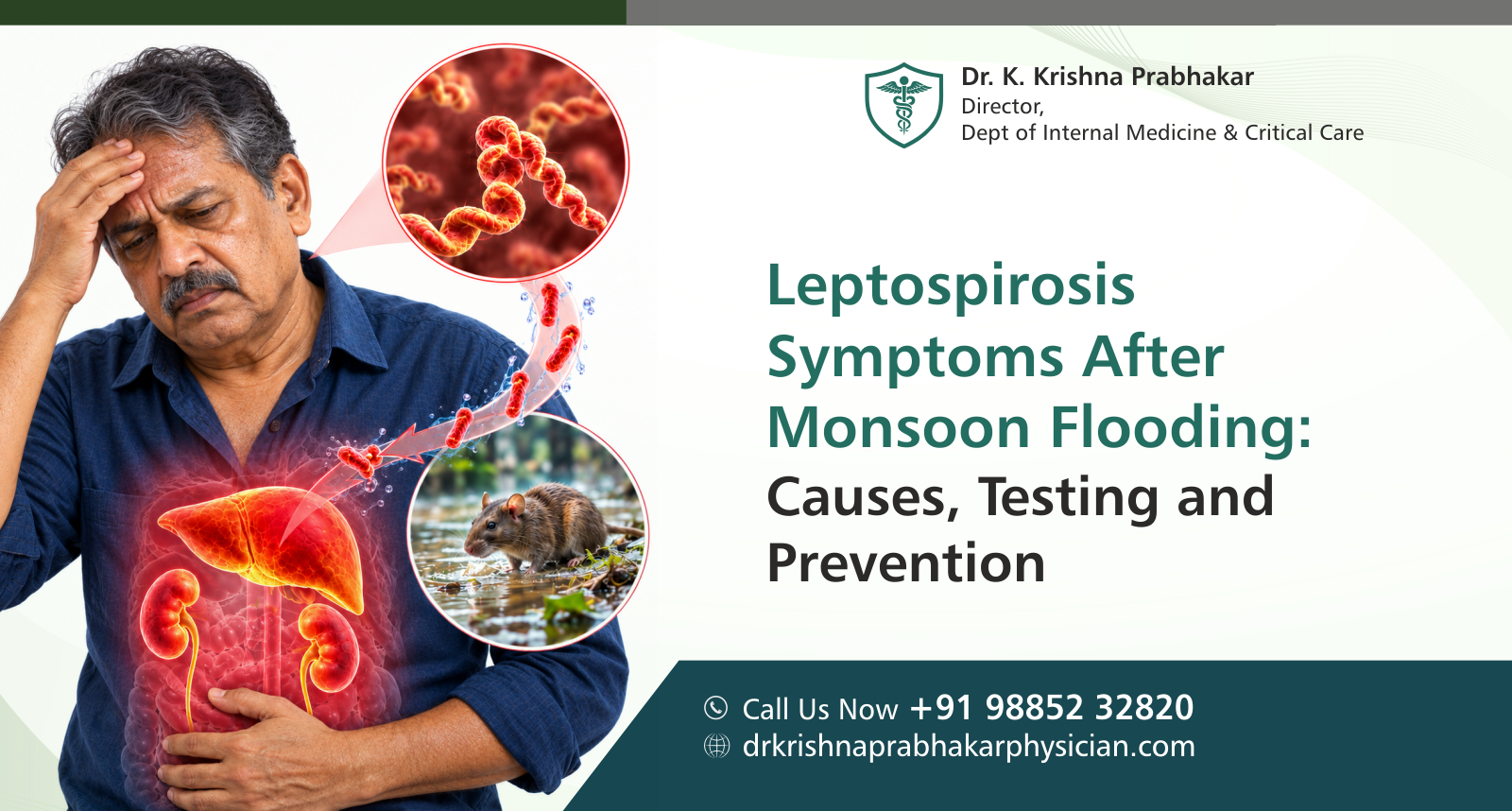
Leptospirosis is a bacterial infection that spreads through water or soil contaminated with the urine of infected animals, especially rats. The bacteria can enter through cuts, scratches or the lining of the eyes, nose and mouth, so wading through floodwater or waterlogged streets is a classic risk. Illness usually begins 5 to 14 days after exposure, though it can take anywhere from 2 to 30 days, with fever, headache, severe muscle pain (especially in the calves) and red eyes. Because these symptoms look like dengue or viral fever, it is often missed. If you develop fever after contact with floodwater, tell your doctor about the exposure and ask about testing. Early antibiotics can prevent serious complications affecting the kidneys, liver and lungs.
Fever after walking through floodwater?
Consult Dr. Krishna Prabhakar for prompt evaluation and testing to identify the cause of your fever and start the right treatment early.
Key Takeaways
- Leptospirosis is caused by Leptospira bacteria in water or soil contaminated by animal urine. It is not usually spread from person to person.
- In a reply to Parliament in July 2026, the Health Ministry reported 210 leptospirosis cases in Delhi up to June 2026, more than the city’s malaria and chikungunya cases combined in that period.
- Symptoms commonly start 5 to 14 days after exposure and mimic dengue and viral fever, so a history of floodwater contact is a vital clue.
- Calf muscle pain, red eyes without discharge and yellowing of the eyes or skin should raise suspicion.
- Tests may be negative in the first few days, so a doctor may repeat them or start treatment based on suspicion.
- Do not self-medicate. Preventive or treatment antibiotics should be prescribed by a doctor.
When should you seek emergency care for leptospirosis?
Most people with leptospirosis have a mild illness, but some develop severe disease quickly. Go to a hospital immediately if you have yellow eyes or skin, very little or dark urine, shortness of breath, coughing up blood, chest pain, unusual bleeding, severe vomiting, confusion, or a severe headache with a stiff neck. These can signal kidney, liver, lung or brain involvement and need urgent treatment.
Why is leptospirosis a concern after monsoon flooding?
Heavy rain mixes sewage, garbage and animal waste into standing water, creating ideal conditions for Leptospira bacteria to survive and spread. People then come into contact with this water while commuting, cleaning flooded homes, working in drains or playing outdoors. The figures show that this is not a rare problem. In a reply to Parliament in late July 2026, the Ministry of Health and Family Welfare reported that Delhi had recorded 360 dengue, 46 malaria, 21 chikungunya and 210 leptospirosis cases up to June 2026.
These Delhi numbers are provisional and describe only one city, but the pattern applies wherever floodwater and waterlogging occur, including Hyderabad. Officials also caution that the peak season for monsoon infections runs from August to October, so the risk is not over yet. Many people assume that only visibly dirty water is dangerous, but water that looks clear can also carry the bacteria. To learn more about this infection, read our earlier guide on leptospirosis after walking in rainwater.
How do you get leptospirosis? Causes and risk factors
Leptospirosis spreads when the urine of infected animals, mainly rats but also cattle, dogs and other animals, contaminates water, mud or soil. The bacteria enter through broken skin or through the eyes, nose and mouth. It is not usually spread from person to person. Anyone exposed to contaminated water or soil can be affected, but some groups are at higher risk.
Higher-risk situations include:
- Wading or walking barefoot through floodwater or waterlogged streets
- Walking through water with cuts, scratches or foot sores
- Cleaning drains, sewers or flooded homes and shops
- Farm work, especially in wet fields, and handling cattle
- Children playing in puddles and flooded areas
- Keeping dogs or livestock that may be infected
- Swimming or bathing in stagnant or contaminated water
What are the symptoms of leptospirosis?
Leptospirosis can range from no symptoms or a mild flu-like illness to a life-threatening condition. In many people it begins suddenly. The first phase usually lasts about a week, and some patients improve briefly and then get worse again in a second phase when the organs may be affected. This two-stage pattern is one reason the illness is easy to underestimate.
Early symptoms may include:
- High fever with chills
- Severe headache
- Intense muscle pain, especially in the calves and lower back
- Red eyes without much discharge
- Nausea, vomiting, abdominal pain or diarrhoea
- Sometimes a skin rash
Signs of severe disease, sometimes called Weil’s disease, include:
- Yellowing of the skin and eyes (jaundice)
- Reduced urine or kidney failure
- Bleeding, including from the lungs
- Breathlessness or chest pain
- Confusion or neck stiffness
The CDC notes that Weil’s disease, which involves kidney and liver failure, has a case-fatality ratio of 5% to 15%, which is why early recognition matters.
When should you suspect leptospirosis and not dengue or viral fever?
Leptospirosis is often mistaken for dengue, typhoid or ordinary viral fever because the early symptoms overlap. The clue that most often separates it is exposure: a fever that appears days to a couple of weeks after contact with floodwater, drains, mud or animal-contaminated water. It is worth suspecting leptospirosis, and telling your doctor about the exposure, when you have fever plus one or more of the following:
- You waded through floodwater or cleaned a flooded area in the last 2 weeks
- Severe calf or thigh pain that makes walking difficult
- Red eyes without a lot of discharge
- Yellow eyes or skin, or dark urine
- Fever that improves for a day or two and then returns with new symptoms
- Reduced urination, breathlessness or unusual bleeding
The table below shows how it compares with other common monsoon fevers. These are clues, not confirmation, so testing is always needed.
| Leptospirosis | Dengue | Typhoid | Viral fever | |
|---|---|---|---|---|
| Key trigger | Contact with floodwater or contaminated soil | Mosquito bite | Contaminated food or water | Spread from other people |
| Typical clues | Calf pain, red eyes, jaundice, reduced urine | Pain behind the eyes, rash, low platelets | Fever that builds over days, abdominal discomfort | Cold, sore throat, body ache |
| Usual start after exposure | 5 to 14 days (range 2 to 30) | About 4 to 10 days | 1 to 3 weeks | 1 to 3 days |
| Main tests | PCR early, antibody tests later | NS1, IgM/IgG, platelets | Blood culture | Usually clinical |
For more on telling fevers apart, read our guide on dengue, malaria and viral fever.
Not sure if your fever is leptospirosis? Don’t guess, get tested
A doctor who knows about your floodwater exposure can choose the right tests and decide whether to start treatment while waiting for results. Book a consultation with Dr. Krishna Prabhakar at Renova Century Hospitals, Banjara Hills, for timely fever evaluation. You can also learn about our specialities, including infectious disease and fever management.
How is leptospirosis diagnosed? Tests for leptospirosis
Leptospirosis is diagnosed by combining your history, examination and lab tests. Timing matters a great deal. Antibodies take time to appear, so tests done in the first few days may be negative even when the infection is present. The CDC explains that antibodies develop 3 to 10 days after symptoms begin, and that a negative PCR test does not rule out the disease.
Tests your doctor may use include:
- PCR test: detects the bacteria’s DNA in blood and may help in the early phase.
- IgM ELISA and other antibody tests: become more reliable after about 5 to 7 days of illness, as reported by Hyderabad physicians in a Deccan Chronicle feature.
- Microscopic agglutination test (MAT): the reference serology test, often done on paired samples taken 7 to 14 days apart, but available only in some reference laboratories.
- Blood counts, liver function and kidney tests, and urine tests: show whether organs are affected and how severe the illness is.
- Chest X-ray or other scans: used when breathing problems or bleeding are suspected.
If your first test is negative but your symptoms and exposure fit, a doctor may repeat testing or treat on suspicion. The CDC advises starting antibiotics as soon as leptospirosis is strongly suspected, without waiting for confirmation.
How is leptospirosis treated?
Leptospirosis is treated with antibiotics, and starting early can shorten the illness and reduce the risk of complications. For mild illness, the CDC lists doxycycline as a drug of choice unless it is unsuitable for the patient, with alternatives such as azithromycin, ampicillin or amoxicillin. People with severe disease usually need hospital admission, intravenous antibiotics and supportive care.
Treatment may include:
- An antibiotic chosen by your doctor, taken for the full duration prescribed
- Plenty of fluids, with intravenous fluids if you are dehydrated
- Paracetamol for fever and pain (avoid ibuprofen and other anti-inflammatory painkillers unless your doctor says they are safe, as they can affect the kidneys and bleeding)
- Close monitoring of kidney and liver function
- Dialysis, oxygen or intensive care in severe cases
Do not choose or stop antibiotics on your own. The right drug depends on your age, pregnancy status, allergies and how unwell you are.
Should you take preventive antibiotics after walking through floodwater?
Some health authorities advise a preventive course for people with high-risk exposure. During heavy rains, the Mumbai civic body advised residents who had walked through stagnant water, especially with cuts or wounds, to consult a doctor and consider preventive treatment within 24 to 72 hours. The CDC notes that limited studies suggest doxycycline preventive treatment may help adults with short, high-risk exposures.
However, it is not for everyone and should never be taken casually. A doctor will consider:
- How long and how deep the exposure was
- Whether you have cuts, wounds or foot sores
- Your occupation, such as drain cleaning or farm work
- Pregnancy, age, allergies and other medicines you take
- Whether you already have fever or symptoms, in which case testing and treatment are needed instead
If you have been in floodwater, wash with soap and clean water, and speak to your doctor early rather than waiting for symptoms.
How can you prevent leptospirosis during and after the monsoon?
Prevention is mostly about avoiding contact with contaminated water and limiting rodent access. Small habits make a real difference, especially for children and people who must travel through waterlogged areas. The following steps can lower your risk.
- Avoid walking or wading through floodwater and stagnant water whenever you can.
- Wear gumboots or waterproof footwear if you must go through water, and avoid going barefoot.
- Cover cuts and sores with waterproof dressings before going outdoors.
- Wash your feet, legs and hands with soap and clean water after contact with rainwater or mud.
- Use gloves and boots when cleaning flooded homes, drains or sheds.
- Keep food and drinking water covered and avoid eating or drinking while in flooded areas.
- Do not let children play or swim in puddles, drains or flooded fields.
- Keep your surroundings free of garbage, and store grain and food so rats cannot reach them.
- Keep pets and livestock under veterinary care, and wash hands after handling them.
Good hygiene also protects against other monsoon infections. Our guide on the annual health checkup explains how regular screening helps you spot problems early.
What should you do at home if you have leptospirosis?
Home care supports your treatment but does not replace it. If your doctor has confirmed leptospirosis and agreed that you can recover at home, these measures help you heal safely. Report any change in how you feel straight away, because the illness can worsen in the second week.
- Take your antibiotics exactly as prescribed and finish the course.
- Drink plenty of water and oral rehydration solution.
- Rest, and eat light, freshly cooked food.
- Use paracetamol for fever and pain, as advised by your doctor.
- Track your temperature and how much urine you are passing.
- Attend all follow-up visits and blood tests.
- Return to hospital if you notice yellow eyes, dark or reduced urine, breathlessness, bleeding or worsening weakness.
When should you see a doctor after floodwater exposure?
Do not wait for severe symptoms before asking for help. See a doctor soon if:
- You develop fever within 2 weeks of walking or working in floodwater or dirty water
- You have severe calf pain, red eyes or a rash with fever
- Your fever has not improved within 2 to 3 days, or it improves and then returns
- You have been taking medicines without getting better
- You have cuts or wounds that were exposed to floodwater
- You are pregnant, elderly or living with diabetes, kidney or liver disease
Seek emergency care immediately if you have yellow eyes or skin, very little urine, breathlessness, bleeding or confusion.
Don’t Guess, Get Tested
Leptospirosis, dengue, typhoid and viral fever can look alike in the first few days, but they are treated differently, and leptospirosis can turn serious quickly. If you have a fever after floodwater exposure, tell your doctor about it early. The right test and treatment can make all the difference.
Book a consultation with Dr. Krishna Prabhakar for timely fever evaluation and testing, or call 98852 32820.
Frequently Asked Questions
What are the first symptoms of leptospirosis?
Typically sudden fever with chills, severe headache, intense muscle pain (especially in the calves) and red eyes. Some people also have nausea, vomiting or a rash.
How long after exposure do leptospirosis symptoms start?
Illness usually begins 5 to 14 days after exposure, but it can appear anywhere from 2 to 30 days later.
How do you get leptospirosis from floodwater?
Through contact with water or soil contaminated by the urine of infected animals, especially rats. The bacteria enter through cuts, scratches or the eyes, nose and mouth.
Is leptospirosis the same as dengue?
No. Leptospirosis is a bacterial infection linked to contaminated water, while dengue is a viral infection spread by mosquitoes. They can look similar early on, so testing is needed to tell them apart.
Can leptospirosis spread from person to person?
It is not usually spread from person to person. Infection generally comes from contaminated water, soil or infected animals.
What is the best test for leptospirosis?
It depends on timing. PCR may help early in the illness, while antibody tests such as IgM ELISA and MAT are more useful after the first week. A negative early test does not rule it out, so your doctor may repeat testing.
How is leptospirosis treated?
With antibiotics, such as doxycycline for mild cases, and hospital care with intravenous antibiotics for severe cases. Treatment should be started early and chosen by a doctor.
Should I take antibiotics after walking in floodwater?
Only if your doctor advises it. Preventive antibiotics may be recommended for high-risk exposures, but they are not suitable for everyone, so consult a doctor within a day or two of exposure instead of taking medicines on your own.
Is leptospirosis dangerous?
Most cases are mild, but severe leptospirosis can damage the kidneys, liver and lungs. Early diagnosis and treatment greatly improve the outlook.
How can I prevent leptospirosis during the monsoon?
Avoid wading through floodwater, wear waterproof footwear, cover cuts, wash with soap and clean water after exposure, control rats and keep food and water covered.